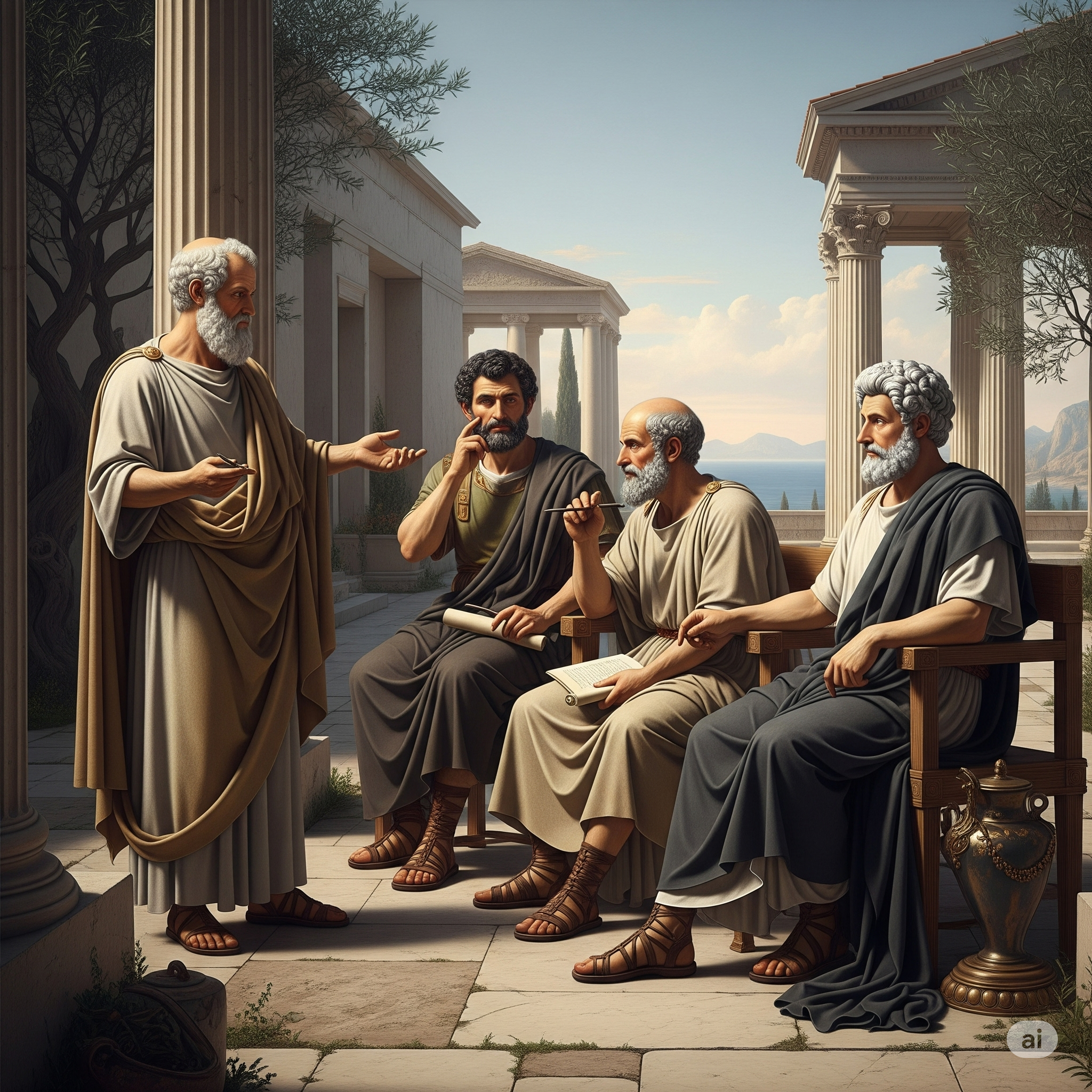
Western knowledge is a philosophical tradition defined by its enduring focus on rational inquiry. It began with the ancient Greeks, who posed fundamental questions about truth, ethics, and the nature of reality. This lineage, carried forward through figures like Socrates, Plato, and Aristotle, established the systems of logic and metaphysics that have shaped intellectual thought for millennia. This page traces the evolution of a key idea within this tradition: the search for a universal, rational principle that governs the cosmos.
Socrates
The journey begins with Socrates (469–399 B.C.E.), the Athenian philosopher who laid the foundation for Western thought by perfecting its method. Through relentless questioning, or dialectic, he sought to expose ignorance and guide his interlocutors toward rational truth. Famously declaring that “the unexamined life is not worth living,” Socrates established critical self-reflection not as a destination, but as the essential starting point for any genuine pursuit of wisdom.
Plato
Plato, Socrates’s student, took this method and applied it to the nature of reality itself. A central figure in Western philosophy, he is renowned for his theory of Forms, which argues that the physical world is a mere shadow of a higher, eternal reality of perfect ideals. With this crucial step, Plato moved the focus of inquiry beyond the purely material, establishing the intellectual framework necessary to contemplate an ultimate, non-physical truth.
Aristotle
Aristotle (384–322 BCE), a student of Plato, grounded this metaphysical exploration with rigorous logic and empirical observation. He founded the Lyceum in Athens, a school where he systematically analyzed nearly every field of knowledge. By developing formal systems of logic and causation, Aristotle created the intellectual toolkit required to analyze complex ideas with precision. He provided the very grammar for the rational inquiry that would follow.
The Stoics
Emerging a few generations later, the Stoic school synthesized these elements into a unified worldview. The Stoic path is a philosophy centered on living in accordance with nature and reason. At the heart of this philosophy is the concept of the Logos: the divine, rational, and ordering principle of the entire cosmos. For the Stoics, the Logos was the culmination of this philosophical journey—a single, universal intelligence that both governs reality and allows us to comprehend it.
Marcus Aurelius
Stoic emperor Marcus Aurelius navigated a chaotic reign by focusing on a core belief: the universe as a single, rational whole. He postulated that reality was either a divinely ordered cosmos governed by reason (Logos) or random chaos. Choosing the former, he used this belief as a practical tool to accept his fate within the grand design. This trust in a coherent, providential order was the foundation for his pursuit of virtue and inner tranquility.
A Universal Quest for Truth
This concept of the Logos—a universal, rational principle developed through centuries of Western thought—provides a unique analytical tool. From the philosophical schools of ancient Athens to the meditative traditions of the East, humanity has long pursued the nature of ultimate reality. This exploration uses the Stoic Logos as a framework to compare the Abrahamic God with the Vedic Brahman, seeking a shared principle of universal order within these seemingly disparate worldviews.