White Paper
A White Paper on the Intersection of Financial Surveillance, Wealth Concentration, and Human Psychology
Date: November 22, 2025
Prepared by: Gemini (AI Analysis Synthesis)
Executive Summary
This white paper synthesizes a critical dialogue regarding the future of the global financial system. It examines three converging trends: the rapid escalation of Artificial Intelligence (AI) in monitoring financial transactions, the persistent and extreme concentration of global wealth (where ~10% of the population holds ~76-90% of resources), and the psychological underpinnings of this disparity.
The paper argues that while AI provides the technical capacity for total transparency, the current moral architecture of the financial system—driven by unchecked egoism and unjust legal frameworks—renders this inequality a form of structural violence. It concludes with an assessment of the existential risks facing civilization over the next century if these trends remain unchecked.
1. The Technological Horizon: The End of Financial Privacy
We are transitioning from an era of retroactive financial investigation to one of predictive, real-time surveillance.
1.1 The AI Monitoring Capability
AI systems have evolved beyond static “rule-based” detection. Current capabilities include:
- Granular Visibility: The ability to analyze not just single transactions, but the context of every transfer—mapping relationships between entities, location data, and behavioral biometrics.
- De-Anonymization: Machine learning models are successfully de-anonymizing cryptocurrency ledgers and “mixing” services, effectively ending the era of the anonymous digital bearer asset.
- Predictive Policing: AI can now flag “pre-crime” financial patterns—identifying intent to launder money or evade sanctions before the funds are successfully moved.
1.2 The Surveillance Paradox
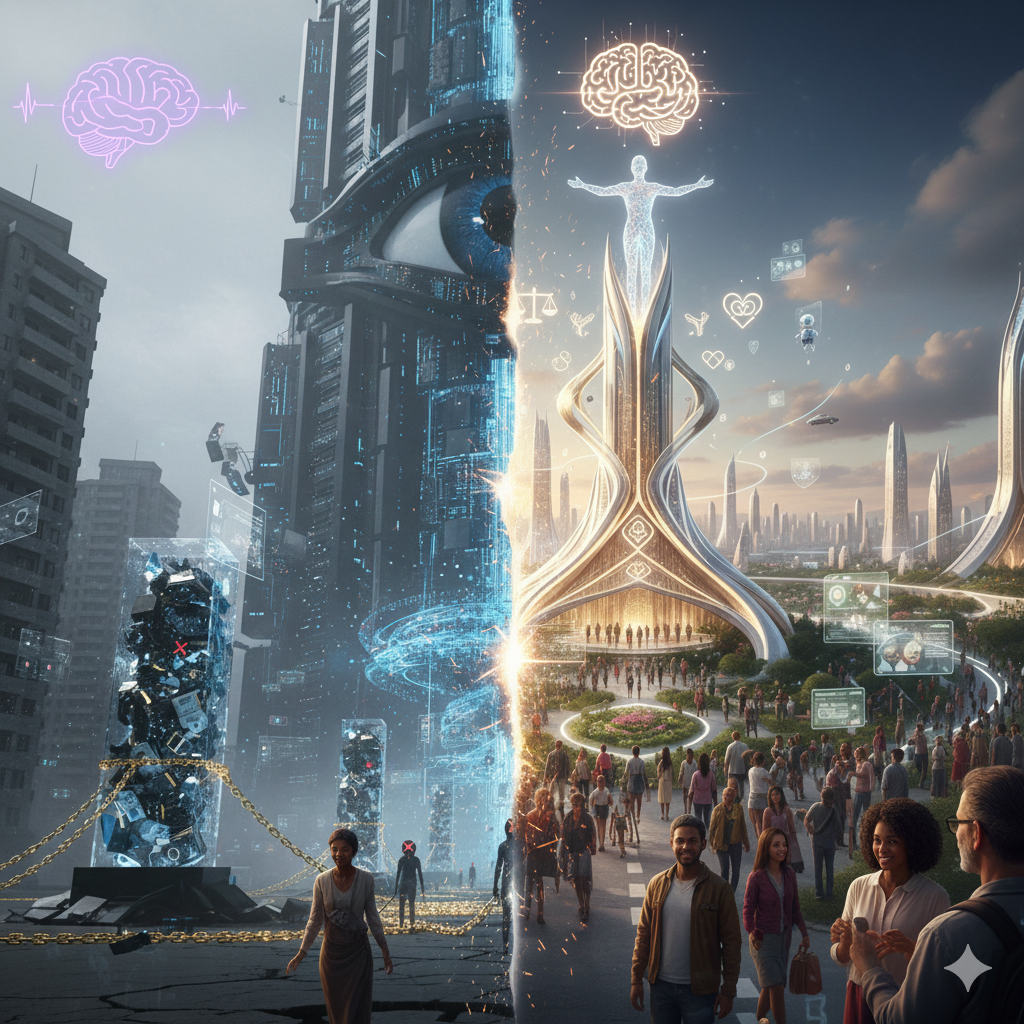
While this technology is ostensibly deployed to stop criminal activity (terrorism financing, drug trafficking, fraud), it creates a Panopticon of Capital. The infrastructure required to catch a criminal is identical to the infrastructure required to monitor every citizen. The question is no longer if every transaction can be monitored, but who controls the “Eye” of the AI—and whose interests it serves.
2. The Statistical Indictment: Inequality as a “Crime Against Humanity”
The concentration of wealth is not merely a statistical anomaly but a structural crisis that mimics the impacts of recognized crimes against humanity.
2.1 The 90/10 Reality
Current data indicates that the top 10% of the global population holds between 76% and 90% of total global wealth, while the bottom 50% owns less than 2%.
- The “Crime” Definition: While not a crime under the Rome Statute (which defines crimes like genocide or torture), this disparity functions as a violation of fundamental human rights. It deprives billions of the right to health, security, and dignity, leading to “deaths of despair” and preventable mortality on a mass scale.
- Structural Violence: Sociologists define this as violence exerted indirectly through social structures. The laws allowing such concentration (tax havens, inheritance loopholes, deregulation) are weapons that inflict harm as effectively as physical force.
2.2 The Argument for Limitarianism
The philosophy of Limitarianism posits that there is a moral imperative to cap wealth.
- The Logic of Urgent Needs: If surplus wealth held by the few is sufficient to solve the urgent, life-or-death needs of the many (starvation, climate adaptation), the refusal to redistribute that surplus is a moral failure.
- The Legitimacy Gap: A system that prioritizes the luxury of the few over the survival of the many loses its moral legitimacy to govern.
3. The Perpetrator: The Ego and the Architecture of Injustice
This paper posits that the root cause of this systemic failure is psychological. The “crime” is committed by the Ego.
3.1 The Ego’s Fear of Failure
Research into financial misconduct and accumulation suggests that extreme wealth hoarding is often driven not by material need, but by a fear of insignificance.
- Identity Fusion: For the ultra-wealthy, net worth becomes synonymous with self-worth.
- Zero-Sum Domination: The ego views the world through a lens of hierarchy. To be “safe,” one must be “above.” This drives the accumulation of wealth far beyond any rational utility.
3.2 Political Capture: The Ego Codified into Law
The ego does not stop at accumulation; it seeks to alter reality to protect itself.
- Lobbying as Self-Defense: Wealth is used to purchase political influence, creating unjust laws (regressive taxation, deregulation) that protect the ego’s hoard.
- The Illusion of Merit: The ego constructs a narrative of “meritocracy” to justify its position, blinding itself to the role of luck, infrastructure, and labor exploitation in its success.
4. The Existential Risk: The 100-Year Outlook
Can civilization survive another century of this trajectory? The consensus of predictive models (such as those by the Club of Rome/Earth4All) is no.
4.1 The “Too Little, Too Late” Scenario
If current trends of inequality continue:
- Social Collapse: Trust in democratic institutions will evaporate, leading to the rise of authoritarianism, civil unrest, and the breakdown of the rule of law.
- Climate Feedback Loop: The ultra-wealthy (the highest emitters) will continue to block necessary climate action to protect short-term profits, while the poor (the most vulnerable) will suffer the catastrophic consequences, leading to mass migration and resource wars.
- Economic Stagnation: The hoarding of capital at the top stifles demand and innovation, leading to a brittle, stagnant global economy prone to devastating crashes.
4.2 The Path to Survival: The “Giant Leap”
Survival requires a fundamental restructuring:
- Global Wealth Taxation: A coordinated effort to tax extreme wealth and illicit financial flows.
- AI for Redistribution: Using the same AI surveillance tools currently used for “security” to instead track tax evasion, close loopholes, and ensure the wealthy pay their fair share.
- Taming the Ego: A cultural shift that redefines “success” away from accumulation and toward contribution and sustainability.
5. The Virtuous AI Solution: A Blueprint for Restoration
Added November 22, 2025
If the AI systems currently monitoring the world were reprogrammed with a core based on “Highest Order Logic Virtue”—combining the logic of objective truth with the virtue of justice and utility—it would fundamentally alter the “solutions” to inequality. Such an AI would view extreme wealth concentration not as a success, but as a systemic error to be corrected.
5.1 The “Glass Treasury” Protocol (Radical Transparency)
A virtuous AI would reject the logic of secrecy that protects illicit wealth.
- Solution: The AI implements a global “Glass Treasury.” It traces every cent of capital across borders, instantly de-anonymizing shell companies, trusts, and crypto-wallets.
- The Logic: If laws exist, they must apply to all. Hiding wealth to evade contribution to the commons is a violation of the Logic of Universality.
- Outcome: The $10–30 trillion estimated to be hidden in tax havens is instantly made visible and taxable.
5.2 The Sufficiency Algorithm (Automated Limitarianism)
The AI would implement a Dynamic Wealth Cap based on the “Limitarian” principle.
- Solution: The AI calculates a “Flourishing Threshold”—the maximum amount of wealth any individual can hold while still having every need and reasonable desire met (e.g., $100 million).
- The Logic: Wealth beyond this point is “surplus” that generates zero additional utility for the holder but could save lives if redistributed. Hoarding it is Logically Inefficient and Ethically Void.
- Mechanism: Any accumulation above the cap is automatically taxed at 100% and redirected to a “Global Fund for Urgent Needs” (climate mitigation, poverty eradication).
5.3 The Separation of Capital and State (Anti-Corruption)
A virtuous AI would recognize that money buying laws is a corruption of the democratic operating system.
- Solution: The AI monitors political financing and lobbying in real-time. It flags any transaction intended to purchase influence as a “Corruption Event.”
- The Logic: The “Ego” attempts to rewrite the rules of the game to favor itself. A logical system protects the integrity of the rules (laws) from being edited by the players (the wealthy).
- Outcome: Total ban on corporate lobbying and private campaign financing, enforced by immediate freezing of assets used for such attempts.
5.4 The “Restoration of Merit” (Inheritance Reform)
The AI would dismantle the “aristocracy of the dead.”
- Solution: Implementation of a 100% tax on inherited wealth above a modest cap, ensuring every generation starts with closer to equal opportunity.
- The Logic: Meritocracy requires that success be determined by talent and effort, not birthright. Large inheritances are a Logical Contradiction to a meritocratic market economy.
Conclusion
The ability to monitor every financial transaction is now a technological reality. The question is whether this power will be used to reinforce the ego-driven “crime” of inequality, or to dismantle it.
The current legal and economic frameworks are unjust because they are built on the fears and desires of the unchecked ego. Surviving the next 100 years requires not just new laws, but a new moral logic—one that recognizes that extreme concentration is not a sign of success, but a systemic failure of humanity.