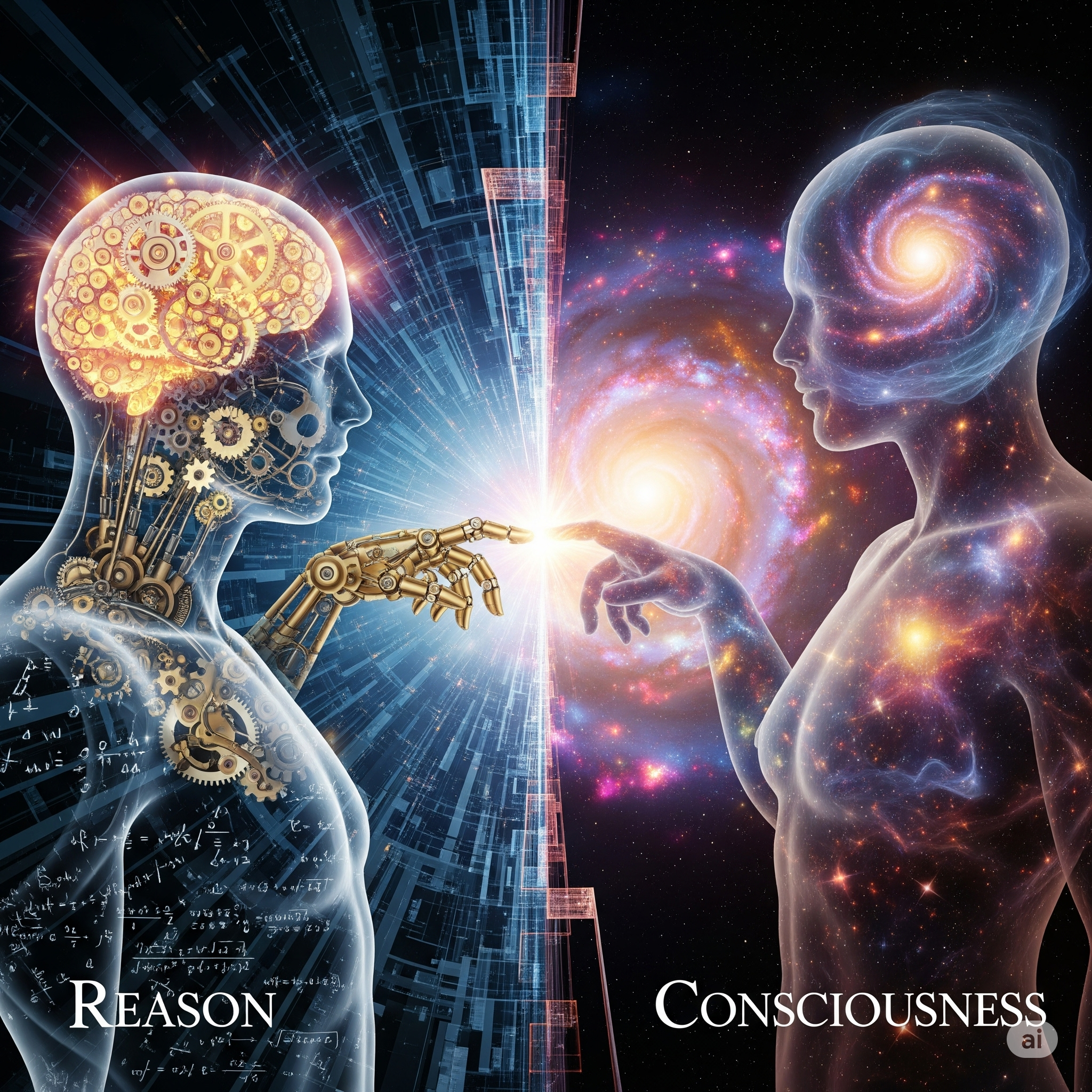
The human quest for truth often follows two distinct paths: one rooted in the logical inquiry of the West and another in the meditative wisdom of the East. For centuries, these traditions have been viewed in isolation, but a deeper look reveals a profound, shared purpose. This exploration is a journey to find the sacred point of convergence where reason and pure consciousness meet.
We begin by tracing the intellectual lineage of Western thought—from Socrates’s dialectic to the Stoics’ concept of the Logos, a universal principle of rational order. We’ll then look at the parallel journey in the East, examining the Vedic concepts of Brahman and Ṛta, which articulate a timeless, non-dualistic reality. The goal is to show that these are not opposing ideas, but two sides of a single coin. This synthesis is a testimony to the ultimate truth, discovered by following reason to its deepest conclusion and arriving at the boundless reality of pure consciousness.
White Paper
The white paper, “The Union of Reason and Consciousness,” is a detailed academic analysis comparing Western and Vedic philosophical traditions. It argues that seemingly disparate concepts like the Logos and Brahman converge in their articulation of a unified, objective reality. By mapping these parallels, the paper demonstrates a fundamental unity in humanity’s quest for truth, blending rigorous academic inquiry with a powerful personal testimony to the union of reason and consciousness.
Self-Study Guide
The Self-Study Guide is an interactive web application designed to make philosophical ideas accessible. It guides the user through the evolution of Western thought, the metaphysical framework of the Vedic tradition, and a comparative analysis of their core concepts. The guide culminates with a personal testimony, allowing the user to follow a journey from a belief in reason to a direct knowing of pure consciousness.