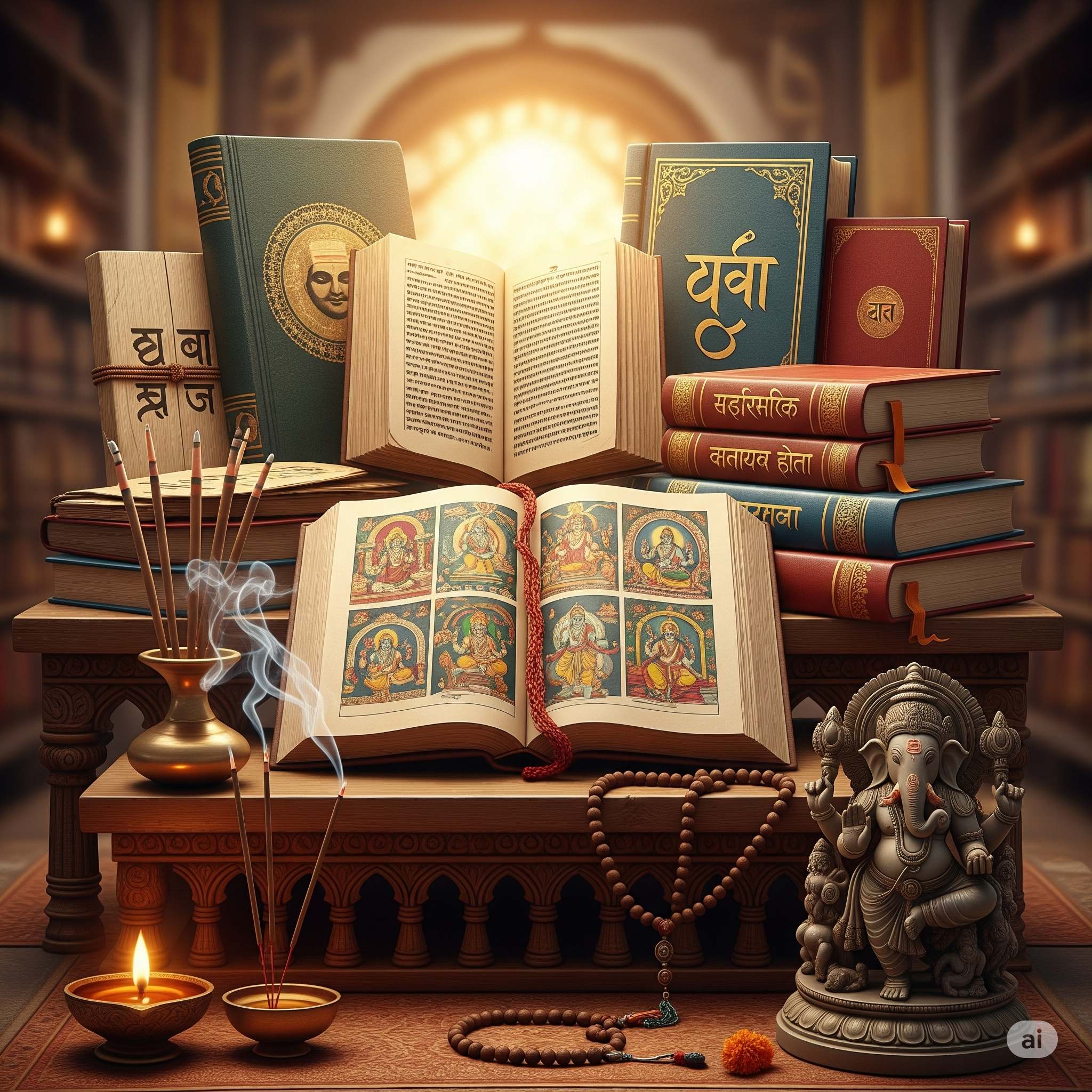
Welcome to a gateway to the foundational texts of Hindu philosophy. Though originally composed in ancient Sanskrit, these scriptures are living traditions that continue to shape the spiritual and philosophical landscape of the world. This page provides an entry point to each of these sacred works, guiding you through their core concepts in clear, modern language.
The Vedas
As the oldest scriptures of Hinduism, the Vedas are the root of this tradition. A vast collection of hymns, prayers, and philosophical insights, they contain the foundational knowledge for Hindu cosmology and rituals, providing the earliest layer of spiritual revelation.
The Upanishads
The Upanishads represent a profound shift from ritual to philosophy. As the final portion of the Vedas, they are ancient texts that explore deep questions about the nature of existence, the ultimate reality (Brahman), and the individual self (Atman), forming the basis for later spiritual thought.
The Mahabharata
This great Sanskrit epic is a sprawling narrative of a dynastic struggle, culminating in the Kurukshetra War. Beyond its dramatic story, the Mahabharata is a rich tapestry of philosophy and morality, exploring complex questions of duty and the nature of good and evil through its timeless lessons.
The Bhagavad Gita
A key scripture from the Mahabharata, the Bhagavad Gita is a timeless dialogue between the warrior Arjuna and Lord Krishna. It synthesizes the teachings of the Upanishads into a practical guide for spiritual living, focusing on selfless action (karma) and one’s duty (dharma).